Overview
2025 Ocean Health Index Scores!
Wed, Dec 03, 2025
This year’s Ocean Health Index (OHI) scores show a world continuing to recover from the COVID-19 pandemic.
This year, the overall global OHI score was 72, which was a 2 point improvement from last year’s score of 70, but still less than the pre-pandemic score of 75.
NOTE: Because OHI assessments rely on reported data, which often lag by two years, our results likely underestimate the true pace of recovery.
Figure 1. Ocean Health Index scores for 2025.
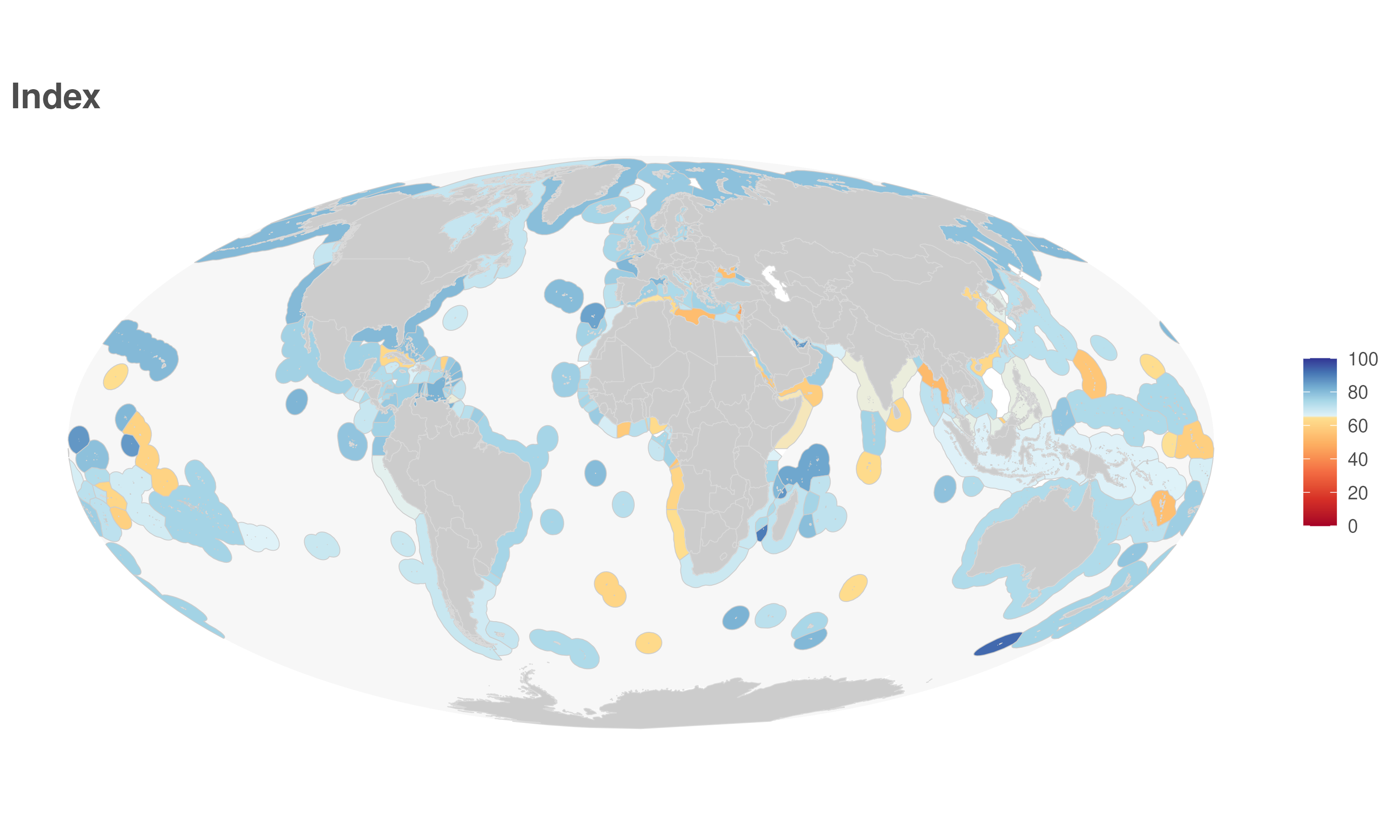
The global Ocean Health Index (OHI, for short) measures how well we are managing the marine resources we depend upon and enjoy. We measure 10 benefits, or goals, that people want and need from the ocean for 220 coastal countries and territories.
Last year we reported the largest decline in global OHI scores ever observed—driven almost entirely by a collapse in tourism and recreation.
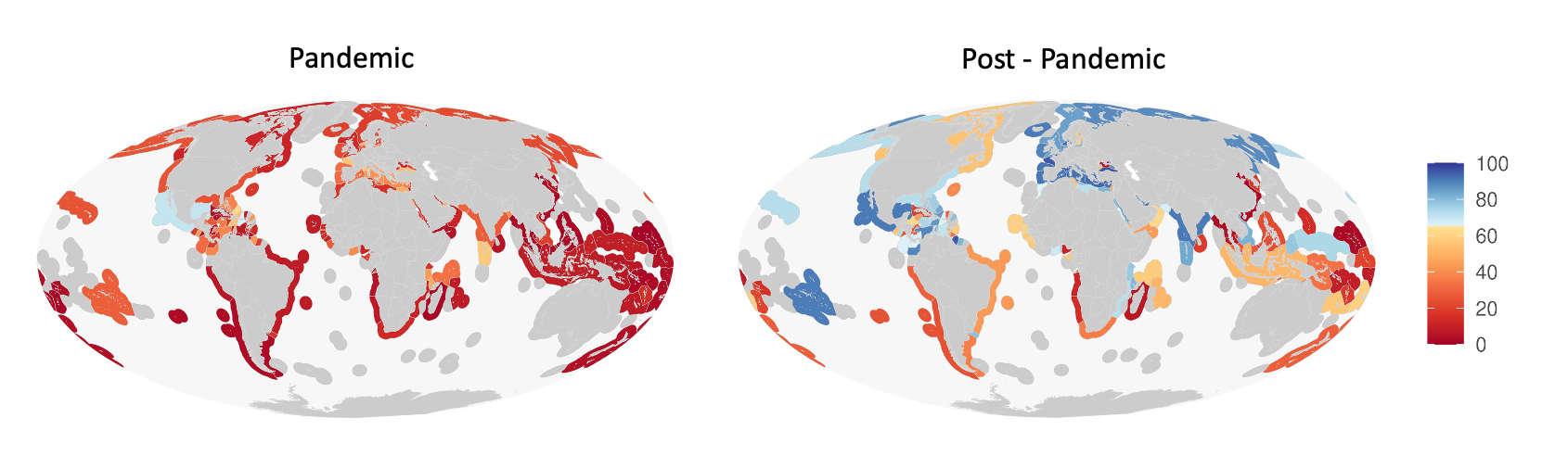
During the pandemic, the global tourism and recreation score plummeted from 93 to 17. This year, it climbed to 56, showing substantial but incomplete recovery. Many regions, especially islands that depend heavily on tourism—such as Vanuatu, Malaysia, Bermuda, American Samoa, and Palau—continue to struggle.
Figure 2. Tourism and recreation scores. Global tourism and recreation scores have improved since 2021.
Livelihoods: A major update!
The Livelihoods & Economies goal measures the jobs and revenue generated by sustainable ocean-related industries. It has two components:
Livelihoods: number and quality of marine-related jobs
Economies: revenue generated by marine sectors
Despite the importance of this goal, we have been unable to update it for more than a decade due to data limitations. This year, thanks to new data sources, we were able to measure livelihoods for fisheries, tourism & recreation, and mariculture.
Like tourism, global livelihoods declined during the pandemic, though less dramatically—dropping from 86 to 81. Scores are improving, but they have not fully returned to pre-pandemic levels.
Mariculture scores continue to slowly increase
Farmed seafood is likely to become an increasingly important food source, especially given the limits of wild fisheries and the relatively low ecological impacts of sustainable mariculture. Although mariculture scores are generally low, we see clear signs of slow but steady growth in sustainable production.
Countries such as Germany, Ecuador, and Portugal have shown particularly strong improvements over time. Last year we worried that global growth was plateauing, but updated FAO data suggests that mariculture production continues to rise gradually.
Global unrest wrecks havoc on marine systems
Conflict and political instability can severely disrupt the management of marine resources. Three of the four regions with the largest recent declines in OHI scores—Yemen, Ukraine, and Libya—are experiencing war or significant internal turmoil, limiting their ability to sustainably manage ocean assets.
Learn more
You can learn more about the OHI Index and explore all the goal scores on our website!
As usual, the 2025 assessment includes a new year of data, calculated using the most recent data available from agencies and other sources. Given our commitment to using the best available science, we also updated previous years’ scores (2012-2024) using the latest science and data when available. The data and code underlying these results are publicly available (Data preparation and Score calculation).